Introduction
If you spend enough time designing data center networks, eventually you encounter the same question:
How do we scale Layer 2 without inheriting all the problems that Layer 2 brings with it?
That question is one of the primary reasons EVPN exists.
Many engineers first encounter EVPN through VXLAN deployments and mistakenly assume EVPN is simply a mechanism for transporting VLANs across a routed fabric. While technically true, that view dramatically understates what EVPN actually provides.
EVPN is fundamentally a control-plane solution to decades-old Ethernet scaling problems.
To understand EVPN properly, you must first understand the problems it was created to solve.
The Evolution of Data Center Networking
Traditional Ethernet Networks
Classic Ethernet networks were simple.
Switches learned MAC addresses by observing traffic.
When a frame arrived:
- Source MAC was learned.
- Destination MAC was looked up.
- If unknown, traffic was flooded.
This model worked remarkably well for small environments.
The challenge appeared when networks became larger.
Suddenly we had:
- Thousands of endpoints
- Multiple switches
- Multiple VLANs
- Redundant paths
Ethernet had no native loop prevention.
A loop meant a broadcast storm.
The solution was:
Spanning Tree Protocol (STP)
STP prevented loops by intentionally blocking links.
This solved one problem while creating several new ones.
Engineers accepted:
- Idle links
- Slow convergence
- Suboptimal forwarding paths
- Large failure domains
For years this was considered normal.
The MLAG Era
As data centers grew, engineers became increasingly frustrated by blocked links.
Technologies emerged such as:
- MLAG (Multi-Chassis Link Aggregation)
- Cisco vPC
- Cisco VSS
- HPE IRF (Intelligent Resilient Framework)
- Juniper MC-LAG
The goal was straightforward:
Allow servers to use multiple active uplinks while avoiding STP limitations.
This worked well.
However, MLAG introduced new challenges:
- Vendor-specific implementations
- Peer-link dependencies
- Operational complexity
- Scalability constraints
- Failure corner cases
Most importantly:
MLAG solved local redundancy. It did not solve network-wide Layer 2 scalability.
VXLAN Changes the Game
VXLAN introduced a powerful idea:
Instead of extending Layer 2 across a switching topology, transport Ethernet frames across a routed IP network.
The underlay became Layer 3.
The overlay became Layer 2.
This was revolutionary.
Suddenly:
- ECMP became available everywhere.
- Spanning Tree disappeared from the fabric core.
- Scale increased dramatically.
- Link utilization improved.
VXLAN created a much better data plane.
However, it introduced a major problem.
VXLAN Flood-and-Learn
Early VXLAN deployments relied on flood-and-learn behavior.
This closely resembled traditional Ethernet.
Unknown destinations still required flooding.
ARP requests still required flooding.
MAC discovery still relied on data-plane learning.
The result was familiar:
- Excessive BUM traffic
- Unknown unicast flooding
- Large flood domains
- Limited operational visibility
VXLAN solved transport.
It did not solve learning.
That is where EVPN enters the picture.
Understanding the Problem Before Understanding EVPN
One of the biggest mistakes engineers make is trying to learn EVPN before understanding the problems it addresses.
EVPN is much easier to understand when viewed as a solution rather than a protocol.
Unknown Unicast Flooding
Consider a host attempting to communicate with another host.
The switch has not learned the destination MAC.
What happens?
The frame is flooded.
Traditional Ethernet relies on flooding to discover destinations.
This is acceptable in small environments.
It becomes increasingly problematic when:
- Thousands of endpoints exist
- Hundreds of racks exist
- Workloads move frequently
Every unknown destination generates unnecessary traffic.
At sufficient scale this becomes operationally expensive.
Broadcast Domain Growth
Broadcast traffic never scales well.
Examples include:
- ARP
- DHCP
- Neighbor discovery
- Service discovery protocols
As broadcast domains grow:
- CPU utilization increases
- Network overhead increases
- Convergence slows
- Troubleshooting becomes harder
Large Layer 2 domains eventually become operational liabilities.
MAC Table Scalability
Traditional switches learn MAC addresses dynamically.
Every endpoint consumes table resources.
Modern environments often contain:
- Virtual machines
- Containers
- Kubernetes workloads
- Bare-metal servers
MAC scale can grow rapidly.
The challenge becomes:
How do devices learn only what they need without relying on flooding?
Mobility Challenges
Modern workloads move.
Frequently.
Virtual machines migrate.
Containers restart.
Applications relocate.
Traditional Ethernet was never designed with rapid mobility as a primary requirement.
The network must quickly determine:
- Where the endpoint moved
- Which path is active
- Which location is stale
Without efficient signaling, convergence becomes slow.
Multi-Homing Challenges
Engineers want:
- Redundancy
- Load balancing
- Fast failover
Traditional Ethernet achieves this imperfectly.
MLAG improves matters but introduces operational dependencies.
The challenge becomes:
How do multiple switches present themselves as a single attachment point while maintaining independent control planes?
EVPN introduces standards-based multi-homing using Ethernet Segments (ESI), eliminating many of the operational dependencies associated with traditional MLAG designs.
Failure Convergence
Large-scale networks fail continuously.
Links fail.
Optics fail.
Servers fail.
Switches fail.
The objective is not preventing failures.
The objective is minimizing impact.
Traditional Ethernet often discovers failures reactively.
EVPN introduces proactive signaling mechanisms that dramatically improve convergence behavior.
Why These Problems Matter More Today
Twenty years ago:
- Physical servers dominated
- Workloads rarely moved
- East-west traffic was limited
Today:
- Virtualization is everywhere
- Kubernetes is everywhere
- Cloud operating models dominate
- East-west traffic exceeds north-south traffic
The network must adapt.
Flood-and-learn architectures become increasingly inefficient.
Control-plane learning becomes necessary.
What EVPN Actually Is
Now we can define EVPN correctly.
A surprisingly large percentage of engineers cannot.
Practical Definition
EVPN (Ethernet VPN) is:
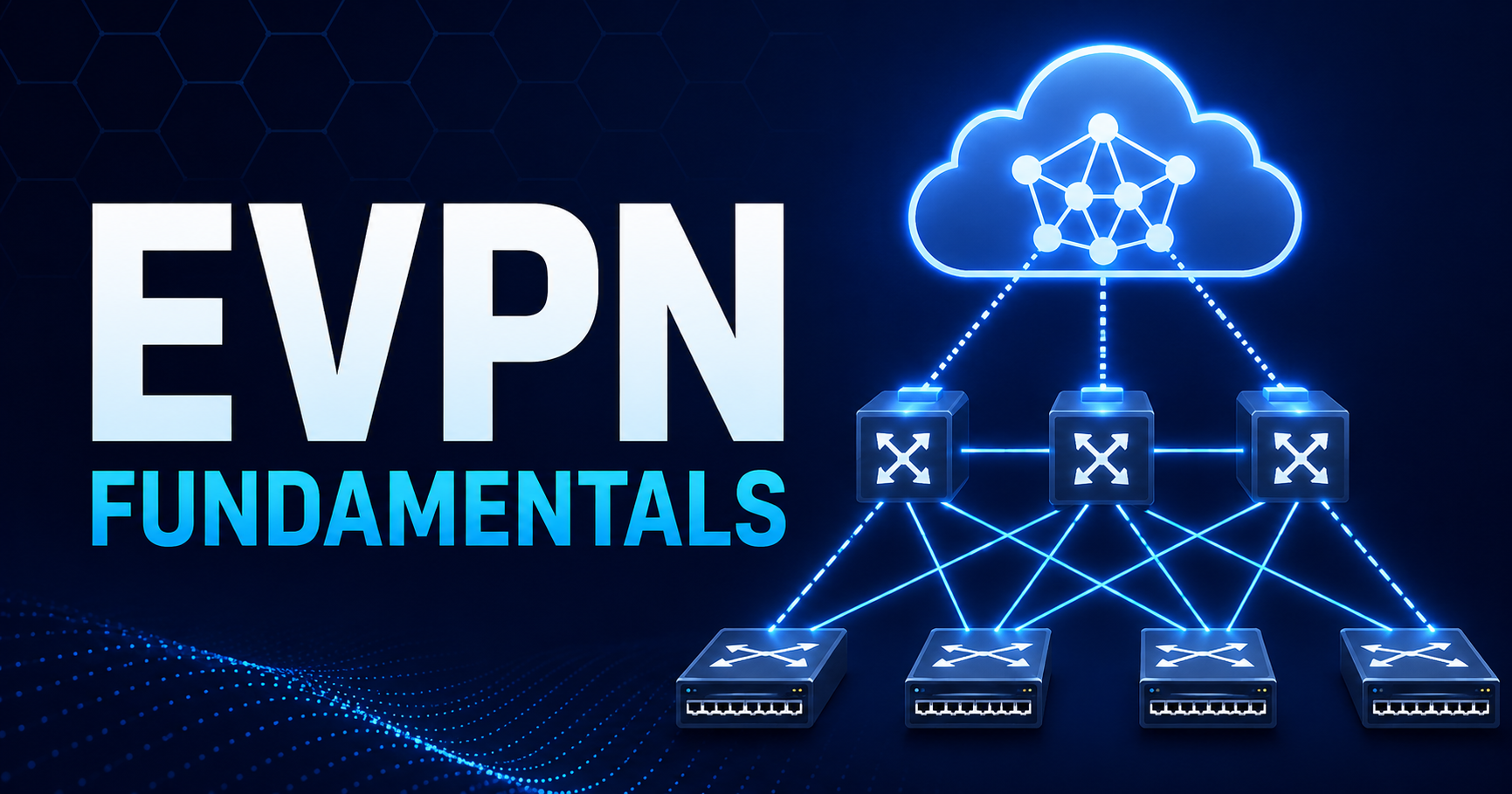
A BGP-based control plane that distributes Layer 2 and Layer 3 reachability information across an overlay network.
Notice what is absent from that definition.
VXLAN.
Because EVPN is not VXLAN.
EVPN Is a BGP Address Family
EVPN operates as an extension of BGP.
Specifically, it uses the EVPN address family.
BGP becomes responsible for advertising:
- MAC addresses
- MAC/IP bindings
- Ethernet segment information
- IP prefixes
- Multi-homing information
Rather than discovering endpoints through flooding, devices exchange endpoint information through BGP.
This is one of the most important concepts in EVPN.
EVPN Is a Control Plane
EVPN’s primary job is:
Distributing endpoint information.
Think of EVPN as a database synchronization mechanism.
Each VTEP learns:
- Which endpoints exist
- Where they reside
- Which VNI they belong to
- Which next hop reaches them
Instead of learning through data traffic.
EVPN Is Not VXLAN
This misconception causes endless confusion.
EVPN ≠ VXLAN.
EVPN = control plane.
VXLAN = data plane.
The two are often deployed together.
But they are independent concepts.
VXLAN Is a Data Plane
VXLAN provides:
- Encapsulation
- Transport
- Segmentation
VXLAN does not provide:
- Endpoint discovery
- MAC advertisement
- Mobility handling
- Multi-homing intelligence
Those functions belong to EVPN.
EVPN Can Operate Over Multiple Encapsulations
Another misconception:
Many engineers assume EVPN requires VXLAN.
It does not.
EVPN originated in service provider networks as a modern replacement for VPLS. Service providers needed a scalable way to distribute MAC reachability information without relying on excessive flooding and data-plane learning.
The same control-plane model later proved extremely valuable in modern data center fabrics, where virtualization, workload mobility, and large-scale Layer 2 extension created similar challenges.
Today, EVPN is widely deployed across both service provider and data center environments.
EVPN supports:
- VXLAN
- MPLS
- SR-MPLS
- SRv6
The control plane remains EVPN.
The forwarding mechanism changes.
This separation is critical.
Understanding the Relationship
Think of the architecture like this:
Application
     |
Endpoint
     |
 EVPN Control Plane
     |
 VXLAN Overlay
     |
 IP Underlay
     |
 Physical Network
Each layer has a different responsibility.
The Underlay
The underlay is simply IP connectivity.
Its job is straightforward:
Deliver packets between VTEPs.
The underlay should not care about:
- VLANs
- MAC addresses
- Tenants
- Workloads
It only provides reachability.
The Overlay
The overlay creates logical network services.
Examples:
- Layer 2 extension
- Tenant isolation
- VRFs
- Distributed gateways
The overlay provides the logical Layer 2 and Layer 3 services. EVPN acts as the control plane that distributes reachability information for those services.
Mental Model Every Engineer Should Remember
If you remember only one thing from this section, remember this:
The underlay transports packets. The overlay transports services. EVPN tells everyone where everything lives.
That single sentence explains most EVPN architectures.
EVPN Building Blocks
Before discussing route types, engineers must understand several foundational concepts:
- Route Distinguishers (RDs)
- Route Targets (RTs)
- VNIs
- VRFs
- MAC advertisements
These form the language EVPN uses to describe network state.
Route Distinguishers (RD)
An RD exists for one reason:
Uniqueness.
Two tenants may use identical addressing.
Example:
Tenant A:
10.1.1.0/24
Tenant B:
10.1.1.0/24
Without differentiation, BGP cannot distinguish them.
The RD creates uniqueness.
Example:
65000:100
65000:200
Now identical prefixes become unique VPN routes.
Important Reality
An RD is not a policy tool.
Many engineers confuse RDs and RTs.
RD:
- Makes routes unique
RT:
- Controls route distribution
These are fundamentally different functions.
Route Targets (RT)
Route Targets determine:
Who imports what.
Think of RTs as membership tags.
Example:
Export RT: 65000:100
Import RT: 65000:100
Any VRF importing that RT receives those routes.
This enables:
- Tenant isolation
- Shared services
- Controlled route leaking
RTs are among the most important EVPN design decisions.
VNI Mapping
VXLAN identifies segments using VNIs.
Traditional VLAN:
VLAN 100
VXLAN equivalent:
VNI 10100
VNIs provide vastly larger scale.
Layer 2 VNI
Represents a bridged domain.
Example:
VLAN 100
VNI 10100
Hosts remain in the same subnet.
Layer 3 VNI
Represents a VRF.
Example:
Tenant-A VRF
L3 VNI 50000
Used for routing between subnets.
MAC Learning Evolution
Perhaps the single most important architectural shift in EVPN is how MAC addresses are learned.
Traditional Ethernet Learning
Traditional switches learn from traffic.
Receive Frame
     |
Learn Source MAC
     |
Populate Table
Advantages:
- Simple
- Automatic
Disadvantages:
- Flooding required
- Slow discovery
- Limited visibility
EVPN Learning
EVPN uses control-plane learning.
Endpoint Appears
     |
VTEP Learns MAC
     |
Advertises Route Type 2
     |
Remote VTEPs Learn Through BGP Advertisement
EVPN moves endpoint learning from a flood-and-learn model to the control plane, significantly reducing unnecessary flooding and improving network scalability.
The endpoint location is distributed proactively.
Why This Matters
Control-plane learning provides:
- Faster convergence
- Better visibility
- Reduced flooding
- Better scaling
- Improved troubleshooting
This is arguably the single greatest benefit EVPN provides.
Key Takeaways Before Moving to Route Types
At this stage, every engineer should understand:
- EVPN exists to solve Ethernet control-plane scaling and operational challenges
- EVPN is a BGP control plane.
- VXLAN is a forwarding mechanism, not a control plane.
- EVPN distributes endpoint information proactively.
- RDs provide uniqueness.
- RTs provide policy.
- VNIs map services into the overlay.
- Control-plane learning replaces flood-and-learn behavior.
In Part 2, we will dive deeply into the EVPN route types (Type 1 through Type 5), explain exactly what each route does, why it exists, how it is created, and how experienced engineers troubleshoot them in production EVPN fabrics.