

In Part 3 we put the default gateway on every leaf.
Same gateway IP. Same virtual MAC. Every host believes its gateway is local, because it is.
That answered where routing happens.
It left a second question open:
When Leaf1 routes a packet toward a host behind Leaf2,
what does it actually put on the wire —
and what is Leaf2 expected to do with it?
EVPN has two answers to that question: asymmetric IRB and symmetric IRB.
Both are defined in the same standard, RFC 9135. Both use the same anycast gateway. Both look almost identical in a lab with two leaves and two VLANs.
They behave very differently in a fabric with 40 leaves, 200 VLANs, a firewall at the border, and a second vendor.
The choice decides:
- Which VLANs must exist on every leaf
- Which tables grow as the fabric grows
- What happens to hosts that never speak first
- How external routes enter the fabric
- Whether two vendors can route to each other at all
This article walks both models packet by packet, then turns them into a design decision.
What IRB Means
IRB stands for Integrated Routing and Bridging.
An IRB-capable VTEP does both jobs on the same box:
Bridging   → forward within a subnet (MAC lookup, L2VNI)
Routing    → forward between subnets (IP lookup in a VRF)
Intra-subnet traffic is the easy case. It is bridged over the subnet’s L2VNI, exactly as described in Part 3. RFC 9135 is explicit that both IRB models treat it the same way.
Symmetric vs. asymmetric is only about inter-subnet traffic.
The Reference Fabric
Every example in this article uses the same small fabric:
VRF TENANT-A               L3VNI 50001  (symmetric only)

VLAN 10  L2VNI 10010  198.51.100.0/24  gateway 198.51.100.1
VLAN 20  L2VNI 10020  203.0.113.0/24   gateway 203.0.113.1

Anycast gateway MAC        02:00:00:00:00:01

Leaf1  VTEP 192.0.2.11     router MAC 02:00:00:11:11:11
Leaf2  VTEP 192.0.2.12     router MAC 02:00:00:22:22:22

Host A 198.51.100.10  MAC 02:aa:aa:aa:aa:aa  VLAN 10  on Leaf1
Host B 203.0.113.20   MAC 02:bb:bb:bb:bb:bb  VLAN 20  on Leaf2
Host A sends a packet to Host B. Different subnet, different leaf.
The spines only carry the underlay, as always.
One Question Separates the Two Models
The question is simple:
Who routes the packet — the ingress leaf, or both leaves?
| Asymmetric IRB | Symmetric IRB | |
|---|---|---|
| Ingress VTEP | Routes and bridges | Routes |
| Egress VTEP | Bridges only | Routes and bridges |
| VNI on the wire | Destination subnet’s L2VNI | The VRF’s L3VNI |
| Inner destination MAC | Destination host | Egress VTEP’s router MAC |
| IP TTL decremented | Once (ingress) | Twice (ingress and egress) |
| Return traffic uses | A different VNI | The same VNI |
The names come from the lookups (RFC 9135 section 4). In symmetric IRB both leaves perform the same MAC → IP → MAC sequence. In asymmetric IRB the ingress performs all three lookups and the egress only one. The VNI pattern in the last row is the visible result.
Everything else in this article follows from that table.
Asymmetric IRB
The Idea
The ingress leaf does all the work.
It routes the packet into the destination subnet, then bridges it across the fabric as if the destination host were on a local VLAN.
The egress leaf receives what looks like ordinary bridged traffic.
For that to work, the ingress leaf must already be in the destination subnet:
Every leaf needs every subnet of the VRF:
  the VLAN
  the L2VNI
  the anycast gateway (SVI / IRB interface)
RFC 9135 says this directly: in asymmetric mode, every PE is configured with all the subnets and MAC-VRFs of the tenant, whether it has hosts in them or not.
Packet Walk: Host A → Host B
Step 1
Host A sees that 203.0.113.20 is off-subnet.
It sends the frame to its gateway:
Dst MAC = 02:00:00:00:00:01   (anycast gateway)
Dst IP  = 203.0.113.20
Step 2
Leaf1 receives the frame on VLAN 10.
The destination MAC is its own gateway MAC, so it routes.
IP lookup in VRF TENANT-A:
203.0.113.0/24 → directly connected, VLAN 20
Leaf1 has VLAN 20 configured, so the destination subnet is local to it.
Step 3
Leaf1 needs Host B’s MAC address to build the frame in VLAN 20.
It already has an ARP entry for Host B, installed from the Type 2 MAC/IP route that Leaf2 advertised (see The Control Plane below):
ARP: 203.0.113.20 → 02:bb:bb:bb:bb:bb (learned from EVPN)
Then a MAC lookup in VLAN 20:
02:bb:bb:bb:bb:bb → remote, VTEP 192.0.2.12, VNI 10020
Three lookups at the ingress: MAC (to see the packet is for the gateway), IP, and MAC again.
Step 4
Leaf1 rewrites the inner Ethernet header and encapsulates:
Outer IP     192.0.2.11 → 192.0.2.12
VXLAN VNI    10020                      (VLAN 20's L2VNI)
Inner MAC    02:00:00:00:00:01 → 02:bb:bb:bb:bb:bb
Inner IP     198.51.100.10 → 203.0.113.20, TTL −1
Step 5
Leaf2 decapsulates. VNI 10020 maps to VLAN 20.
The inner destination MAC is Host B, which is local.
Leaf2 bridges the frame to Host B.
No routing on the egress leaf. One lookup.
The Return Path
Host B replies. Now Leaf2 is the ingress.
Leaf2 routes into VLAN 10, which it must also have, and sends the packet with VNI 10010.
Leaf1 bridges it to Host A.
A → B   VNI 10020
B → A   VNI 10010
Same flow, two different VNIs. That is the asymmetry.
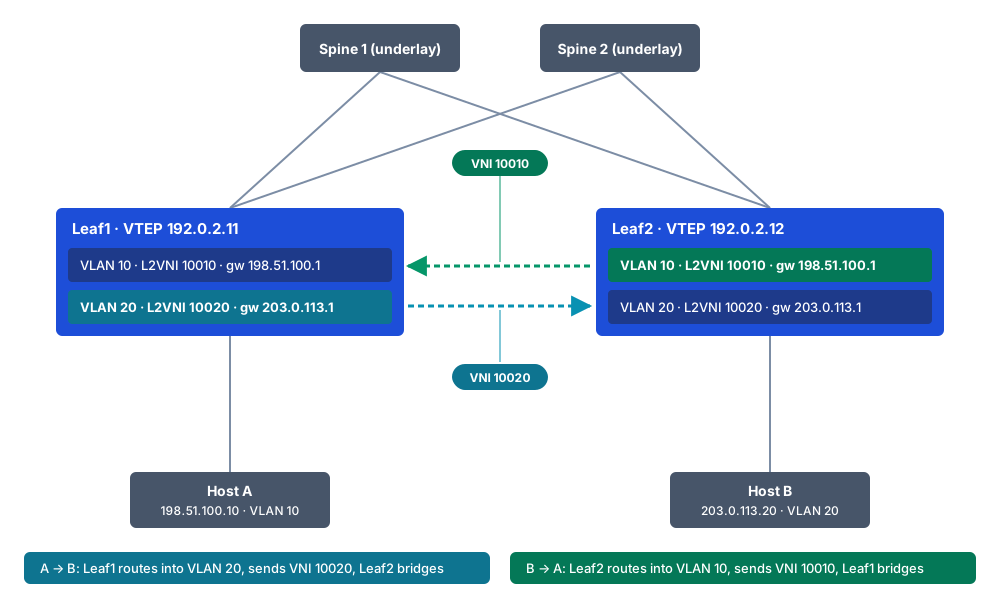
Figure 1: Asymmetric IRB. The ingress leaf routes, the egress leaf bridges, and each direction travels in the destination subnet’s L2VNI.
The Control Plane
Asymmetric IRB needs only what the fabric already has for bridging.
Host B’s leaf advertises a Type 2 MAC/IP route:
Type 2 MAC/IP
  MAC      02:bb:bb:bb:bb:bb
  IP       203.0.113.20
  Label    10020    (L2VNI only)
RFC 9135 says the route carries a single label in this mode. There is no VRF label, because there is no VRF hop across the fabric.
The IP part of the route matters more than it looks.
RFC 9135 has the receiving leaf install the MAC/IP binding from the Type 2 route directly into its ARP table. In asymmetric mode that is mandatory: the ingress writes the destination host’s MAC into the frame, so it must know the MAC of every remote host it routes to. The RFC states it plainly — every PE must maintain ARP entries for remote hosts.
Relying on ordinary ARP instead is fragile with an anycast gateway. If Leaf1 sends its own ARP request from the shared gateway MAC, Host B replies to that MAC — and Leaf2, which owns the same MAC, consumes the reply locally. Whether that happens depends on the platform, which is exactly why the EVPN-learned entry is the reliable path.
Platforms that do not build ARP entries from Type 2 routes cannot run pure asymmetric IRB. Juniper’s NX-OS/Junos interoperability guide shows this behavior for NX-OS (see the interop section).
Strengths
- Simple mental model. Routing happens once, on the ingress. The egress just bridges.
- No extra VNI. No L3VNI, no router MAC, no second label.
- Silent hosts are handled naturally. Every leaf has every subnet, so the ingress can ARP for any destination itself (more on this below).
- One routing hop. TTL decremented once, one routing lookup on the path. Juniper’s documentation lists lower latency as an asymmetric advantage.
Weaknesses
- Every VLAN everywhere. A subnet used by one rack is configured on all leaves.
- Every host everywhere. Each leaf holds MAC entries and ARP/ND entries for every host in the VRF.
- Wider flooding. Every leaf joins every L2VNI, so BUM traffic for every subnet reaches every leaf.
- External routes still need a VRF VNI. Covered in the Type 5 section.
None of this matters with ten VLANs.
All of it matters with two hundred.
Symmetric IRB
The Idea
Both leaves route.
The ingress leaf routes the packet into the VRF and sends it across the fabric in a VNI that represents the VRF, not a subnet. That is the L3VNI.
The egress leaf receives a routed packet, looks up the destination in the same VRF, and routes it again into the destination subnet.
Neither leaf needs the other’s subnets.
Each leaf needs:
  its local VLANs, L2VNIs and gateways
  one L3VNI per VRF
  a router MAC
Two New Pieces
The L3VNI. One VNI per VRF, shared by all leaves that carry the VRF. In our fabric, 50001 for TENANT-A. On the wire it means: this packet was routed; do an IP lookup in TENANT-A.
The router MAC (RMAC). Each VTEP has a MAC address that identifies it as a router in the overlay. It is advertised with EVPN routes in the Router’s MAC Extended Community, defined in RFC 9135 section 8.1. For VXLAN it is required: a routed packet still carries an inner Ethernet header, and the RMAC fills it.
Packet Walk: Host A → Host B
Step 1
Same as before. Host A sends to the anycast gateway MAC.
Step 2
Leaf1 routes. IP lookup in VRF TENANT-A:
203.0.113.20/32 → VTEP 192.0.2.12, VNI 50001, RMAC 02:00:00:22:22:22
Note the /32. Leaf1 does not have VLAN 20. It reaches Host B through a host route built from the Type 2 route Leaf2 advertised.
Step 3
Leaf1 encapsulates:
Outer IP     192.0.2.11 → 192.0.2.12
VXLAN VNI    50001                      (TENANT-A's L3VNI)
Inner MAC    02:00:00:11:11:11 → 02:00:00:22:22:22   (Leaf1 RMAC → Leaf2 RMAC)
Inner IP     198.51.100.10 → 203.0.113.20, TTL −1
Step 4
Leaf2 decapsulates. VNI 50001 maps to VRF TENANT-A.
The inner destination MAC is its own router MAC, so it routes:
203.0.113.20 → local, VLAN 20, MAC 02:bb:bb:bb:bb:bb
TTL is decremented again.
Step 5
Leaf2 rewrites the inner header and delivers the frame to Host B:
Src MAC = 02:00:00:00:00:01   (anycast gateway)
Dst MAC = 02:bb:bb:bb:bb:bb
From Host B’s point of view, the packet came from its own gateway. Exactly what it expects.
The Return Path
Host B replies. Leaf2 routes into VRF TENANT-A and sends the packet with VNI 50001.
Leaf1 routes it into VLAN 10 and delivers it to Host A.
A → B   VNI 50001
B → A   VNI 50001
Same VNI in both directions. Symmetric.
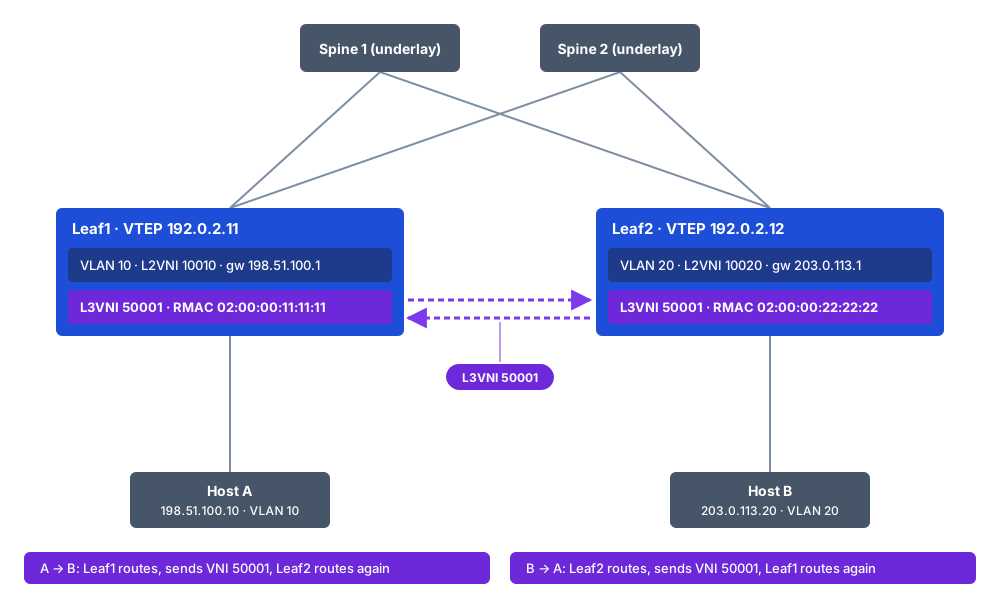
Figure 2: Symmetric IRB. Each leaf carries only its local VLANs plus the VRF’s L3VNI, and both directions use the same VNI.
The Control Plane
The same Type 2 route now carries more information:
Type 2 MAC/IP
  MAC         02:bb:bb:bb:bb:bb
  IP          203.0.113.20
  Label1      10020    (L2VNI — for bridging)
  Label2      50001    (L3VNI — for routing)
  RTs         MAC-VRF RT and IP-VRF RT
  Ext. comm.  Router's MAC 02:00:00:22:22:22
One route, two consumers:
- A leaf that has VLAN 20 imports the MAC into its MAC-VRF and can bridge to Host B.
- A leaf that only has VRF TENANT-A imports the IP into the VRF as a /32 (or /128) host route, with next hop VTEP 192.0.2.12, VNI 50001, and the advertised router MAC.
The route targets decide which of those happens on each leaf. This is why route target design matters even more in a symmetric fabric.
Strengths
- VLANs stay local. A leaf only needs the subnets its hosts use.
- ARP stays local. RFC 9135: a symmetric PE only keeps ARP entries for locally connected hosts.
- Smaller flood domains. A leaf joins only the L2VNIs it carries.
- Same model as external routing. The L3VNI that carries host routes also carries Type 5 prefixes.
Weaknesses
- More moving parts. L3VNI, router MAC, two labels, two sets of route targets.
- Two routing hops. TTL is decremented twice, and traceroute shows both leaves.
- Host routes. Remote hosts become /32 and /128 entries in the VRF table.
- Silent hosts need help. Covered next.
Side-by-Side on the Wire
The outer header is identical. The underlay cannot tell the two models apart.
The difference is entirely inside the tunnel.
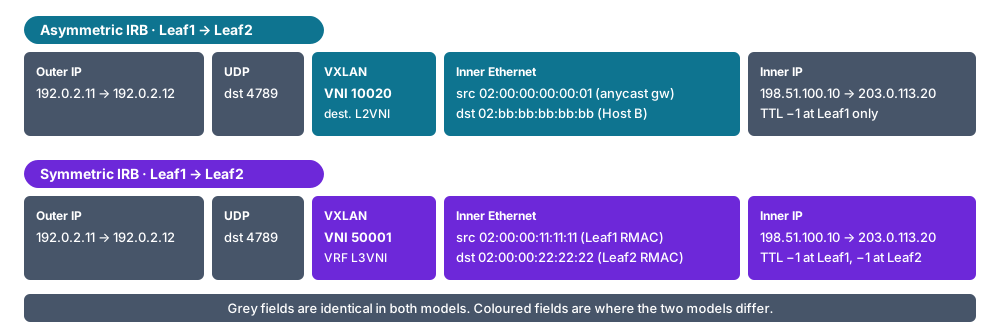
Figure 3: The same packet from Host A to Host B as Leaf1 sends it in each model. Only the VNI, the inner MACs and the TTL handling differ.
This is also the fastest way to identify the model in a packet capture:
VNI is a subnet's L2VNI and inner dst MAC is a host  → asymmetric
VNI is the VRF's L3VNI and inner dst MAC is a VTEP's router MAC → symmetric
Where the State Goes
The usual summary is “symmetric scales better”.
That is true, but it hides what scales better. State does not disappear. It moves.
Take a realistic tenant:
40 leaves
200 subnets (VLANs) in one VRF
10,000 hosts, about 50 per subnet
Each leaf: about 250 local hosts in about 20 of the subnets
Approximate per-leaf state:
| Per leaf | Asymmetric | Symmetric |
|---|---|---|
| VLANs / L2VNIs / gateways | 200 | ~20 |
| L3VNIs | 0 | 1 |
| MAC entries | ~10,000 (every host) | ~1,000 (hosts in the 20 local subnets) |
| ARP / ND entries | ~10,000 (every host) | ~250 (local hosts only) |
| VRF host routes (/32, /128) | none needed (subnets are local) | ~9,750 (remote hosts) |
| L2VNIs flooded to the leaf | 200 | ~20 |
The numbers are a model, not a measurement. Real tables depend on traffic patterns, aging, IPv6, and how each platform stores entries. The shape is the point.
Asymmetric puts the fabric’s whole host population into the MAC and ARP tables of every leaf, and every VLAN into every leaf’s configuration.
Symmetric keeps MAC and ARP tables proportional to what is local, and moves remote hosts into the routing table as host routes.
Why that trade is usually worth it (this is interpretation, not standard text):
- In asymmetric mode every remote host is its own adjacency: a rewrite to that host’s MAC. In symmetric mode the ~9,750 host routes share roughly one adjacency per remote VTEP (its router MAC) — about 40 in this example.
- On many switching platforms the adjacency tables are tighter than the route tables. Check your platform’s scale sheet rather than assuming.
- 200 SVIs on every leaf is configuration, and configuration is where outages come from.
- Flood scope shrinks with the number of VLANs per leaf.
If host-route scale becomes the limit in a symmetric fabric, the next tools are route-target design (do not import tenants a leaf does not serve) and subnet-level Type 5 routes. More on those next.
Silent Hosts: The Classic Symmetric Trap
A silent host is one that has not sent anything yet.
No traffic means no local learning. No local learning means no Type 2 route.
Printers, standby appliances, a freshly booted VM, a storage target that only answers: all can be silent.
Asymmetric Handles It Naturally
Leaf1 has VLAN 20 configured.
Traffic to a silent Host C (203.0.113.30, also in VLAN 20) matches the connected subnet. Leaf1 ARPs for it.
The ARP request floods on L2VNI 10020 and reaches every leaf with VLAN 20. Host C replies, gets learned by its leaf, and is advertised.
Symmetric Needs a Subnet Route
Now assume Leaf1 has no VLAN 20.
It has no connected route for 203.0.113.0/24. It has no /32 for Host C, because Host C has never spoken.
Leaf1 has nowhere to send the packet.
The fix is to advertise the subnet itself as an EVPN Type 5 route from the leaves that own it. RFC 9135 says that for this case PEs must advertise their local subnet routes as Type 5 routes:
Type 5 IP Prefix
  Prefix   203.0.113.0/24
  Label    50001         (L3VNI)
  From     leaves that carry VLAN 20
The flow becomes:
Step 1  Leaf1 matches 203.0.113.0/24 (Type 5) → sends to a leaf with VLAN 20
Step 2  That leaf routes into VLAN 20, has no ARP entry, ARPs for Host C (glean)
Step 3  Host C answers, its own leaf learns it and advertises Type 2
Step 4  Leaf1 installs 203.0.113.30/32 and sends directly from then on
The first packets may be dropped while ARP resolves. That is normal router behavior, not a fabric fault.
NVIDIA’s Cumulus documentation adds a practical detail: do this only for subnets that actually contain silent hosts, and advertise each subnet from one or two VTEPs, not from every leaf that carries it.
In short: in a symmetric fabric without subnet advertisement, a silent host is unreachable from leaves that do not carry its subnet. It will look like an intermittent, host-specific reachability problem.
External Connectivity and Type 5
Sooner or later the tenant needs a default route, a firewall, or a WAN.
Those arrive in the fabric as Type 5 IP prefix routes from the border leaves.
In the common interface-less model from RFC 9136, a Type 5 route is resolved exactly like a symmetric host route: next hop VTEP, the VRF’s VNI, and the border leaf’s router MAC. RFC 9136 also defines interface-ful variants that work differently, but interface-less is what most VXLAN fabrics deploy.
The practical consequence:
Even an "asymmetric" fabric usually ends up with an L3VNI per VRF,
just for external prefixes.
Vendors reflect this. Juniper documents that Type 5 routes support only the symmetric model. Arista’s asymmetric sample configuration still maps a VNI to the VRF.
So the real choice is often not “L3VNI or no L3VNI”. It is whether host routes inside the fabric use it too.
Mixing Models and Multi-Vendor Interop
RFC 9135 allows both modes to coexist, provided the ingress leaf supports both. The egress signals which mode it wants through the second label and the IP-VRF route target in its Type 2 routes, and a dual-mode ingress follows that signal.
In practice, mixed fabrics are where the trouble starts.
Look at it from each side:
Asymmetric leaf receives a symmetric Type 2 route
  → ignores Label2, needs the destination VLAN locally to route

Symmetric leaf receives an asymmetric Type 2 route (one label, no IP-VRF RT)
  → has no VRF next hop for the host
Documented examples:
- Junos with symmetric routing enabled logs an error and rejects Type 2 routes that lack the L3 VNI.
- NX-OS routes symmetrically. Juniper’s NX-OS/Junos interop guide shows NX-OS dropping asymmetric routes because no L2VNI or route target matches. Cisco offers an EVPN Hybrid IRB mode to interoperate with asymmetric peers, with its own restrictions (it is not supported on DCI border gateways).
The rule for multi-vendor fabrics:
Pick one IRB model for the whole VRF, configure it explicitly on every vendor, and test inter-subnet traffic in both directions between every pair of platforms.
Testing in both directions matters. With asymmetric routing involved, A → B can work while B → A fails.
Vendor Reality
Where each platform stands, according to its current documentation. Releases and defaults change, so verify against your version.
| Platform | Models | Notes |
|---|---|---|
| Cisco NX-OS | Symmetric | Asymmetric peers via EVPN Hybrid IRB mode (fabric forwarding mode anycast-gateway hybrid) |
| Arista EOS | Both, per tenant | L3VNI mapped with vxlan vrf <vrf> vni <id> |
| Juniper Junos | Both | Asymmetric is the Type 2 default; symmetric is enabled with irb-symmetric-routing vni under the routing instance’s protocols evpn |
| NVIDIA Cumulus Linux | Both, plus centralized | NVIDIA recommends symmetric or centralized over asymmetric; asymmetric does not support EVPN multihoming |
| FRR | Both | Symmetric when the VRF has an L3VNI (vni in the vrf stanza) |
| SONiC | Both (per design document) | Check the release you run |
A minimal FRR example of the symmetric pieces (control plane only; the Linux VRF, bridge and VXLAN devices are configured separately):
vrf TENANT-A
 vni 50001
exit-vrf
!
router bgp 65001
 address-family l2vpn evpn
  advertise-all-vni
 exit-address-family
!
router bgp 65001 vrf TENANT-A
 address-family ipv4 unicast
  redistribute connected
 exit-address-family
 address-family l2vpn evpn
  advertise ipv4 unicast
 exit-address-family
vni 50001 makes 50001 the L3VNI for TENANT-A. advertise-all-vni enables EVPN in the BGP instance. advertise ipv4 unicast exports the routes in the VRF’s BGP table as Type 5 routes, and redistribute connected is what puts the local subnets into that table. Together they provide the subnet advertisement the silent-host section needs. Following NVIDIA’s advice, configure the subnet part only on one or two leaves per subnet, and only where silent hosts exist.
Choosing a Model
Asymmetric Is Still Reasonable When
- The fabric is small and will stay small
- Nearly every VLAN is needed on nearly every leaf anyway
- All leaves are one vendor that supports it well
- EVPN multihoming on that platform does not depend on symmetric mode
- Operational simplicity outweighs table and flood-scope growth
Symmetric Is the Better Default When
- VLANs are localized to racks, pods or rows
- The number of subnets will grow
- More than one vendor routes in the overlay
- Cisco NX-OS is in the fabric
- The VRF already has an L3VNI for Type 5 routes
- You want ARP state and flood domains proportional to what each leaf actually serves
For most new data center fabrics, the second list wins. Cisco NX-OS is symmetric by design and NVIDIA recommends it; Juniper defaults to asymmetric for Type 2 routes but offers symmetric for exactly these scaling reasons.
The one thing to avoid is not choosing: leaving each platform at its own default and discovering the mismatch during the first multi-vendor change window.
Common Mistakes
Mistake 1 — Symmetric Without Subnet Routes
Host routes only exist for hosts that have spoken.
Without Type 5 subnet advertisement, silent hosts in subnets the ingress leaf does not carry are unreachable until something else wakes them up.
Mistake 2 — Inconsistent L3VNI
The VRF-to-L3VNI mapping must match the design on every leaf. Cumulus requires the same mapping on every VTEP.
A leaf with the wrong L3VNI receives packets it cannot place in any VRF.
Mistake 3 — Forgetting the IP-VRF Route Target
The L3VNI can be correct and host routes can still be missing if the VRF does not import the IP-VRF route target.
Symptom: MAC entries present, /32 routes absent.
Mistake 4 — Mixing Defaults Across Vendors
Asymmetric on one platform, symmetric on another. Traffic within a vendor works. Traffic between them fails in one or both directions.
Mistake 5 — Reading Two Hops as a Fault
In symmetric IRB, traceroute through the fabric shows both the ingress and egress leaf, and TTL drops by two.
That is the design, not a loop.
Mistake 6 — Ignoring Router MAC Details on Multihomed Pairs
With vPC-style leaf pairs, the router MAC and next hop used for routed traffic need deliberate configuration. On NX-OS, features such as advertise-pip exist for this case. Read the platform’s multihoming and Type 5 guidance before deploying.
Troubleshooting by Model
These checks extend the workflow from Part 5.
Asymmetric
1. Does the ingress leaf have the destination VLAN, L2VNI and gateway?
2. Is there a Type 2 MAC/IP route for the destination host?
3. Does the ingress leaf have an ARP entry for the remote host?
4. Is the MAC installed in the destination VLAN pointing at the right VTEP?
5. Does the egress leaf have the VLAN mapped to the same L2VNI?
Symmetric
1. Do both leaves map the VRF to the same L3VNI?
2. Does the Type 2 route carry Label2 and the Router's MAC community?
3. Does the ingress VRF table have a /32 (or /128) for the host?
4. If not: is the host silent, and is its subnet advertised as Type 5?
5. Does the egress leaf have the destination VLAN and an ARP entry for the host?
The fastest single check in a symmetric fabric:
Look at the ingress VRF route for the destination.
/32 via remote VTEP → control plane is fine, look at the egress
Subnet via Type 5   → host not learned yet (silent?)
Nothing             → RTs, L3VNI or subnet advertisement
Key Takeaways
- IRB models only differ for inter-subnet traffic. Intra-subnet traffic is bridged the same way in both.
- Asymmetric: the ingress routes and bridges, the egress only bridges. Packets travel in the destination subnet’s L2VNI.
- Symmetric: both leaves route. Packets travel in the VRF’s L3VNI, between router MACs.
- Asymmetric requires every subnet on every leaf and puts every host into every leaf’s MAC and ARP tables.
- Symmetric keeps VLANs and ARP local and moves remote hosts into the VRF as host routes.
- Symmetric fabrics need Type 5 subnet routes to reach silent hosts.
- External prefixes usually need an L3VNI even in an asymmetric fabric.
- Mixed modes break inter-vendor routing. Choose one model per VRF and configure it explicitly everywhere.
- In a packet capture, the VNI and the inner destination MAC tell you which model is running.
- For most new fabrics, symmetric IRB is the default worth starting from.
References
- RFC 9135 — Integrated Routing and Bridging in Ethernet VPN (EVPN)
- RFC 9136 — IP Prefix Advertisement in Ethernet VPN (EVPN)
- RFC 8365 — A Network Virtualization Overlay Solution Using EVPN
- Cisco — EVPN Hybrid IRB Mode (Nexus 9000 NX-OS VXLAN Configuration Guide, 10.2(x))
- Juniper — Symmetric Integrated Routing and Bridging with EVPN Type 2 Routes
- Juniper — EVPN-VXLAN Interoperability Between NX-OS and Junos OS
- Arista — Integrated Routing and Bridging (EOS User Manual)
- NVIDIA Cumulus Linux — Inter-subnet Routing
- FRR — EVPN


